Seeking Help is Not a Weakness

For more information about Boar's Tusk, click here.
********************************************************************************
Is society failing our men, or are the men failing us? You could argue that it’s both. A man unwilling to seek help could be failing not only himself, but his wife, and family. According to an article through the Anxiety & Depression Association of America “Nearly 1 in 10 men experience some form of depression or anxiety but less than half seek treatment.” (“Why Men’s Mental Health Is Important”) However, a society that isn’t accepting of a man seeking therapy and believes that asking for help is a sign of weakness, is failing our men. Despite the pressure that discourages men from expressing vulnerability, seeking therapy is crucial for men’s mental health.
By engaging in therapy, men can learn healthy coping skills that will empower them to navigate challenges more effectively. According to an online article, “Therapists help men develop healthier communication skills, assertiveness, and active listening, enabling them to build stronger connections with their partners, family members, and friends.” (“Therapy for Men”). Encouraging men to build strong connections with friends, family, and other support systems can provide a sense of emotional support. Unfortunately, seeking help is viewed as a weakness. Most men grew up in homes where their parents told them things like; “Men don’t cry,” “buck-up buttercup,” and “Don’t be a sissy.” Because of this, a lot of men grew up to believe that anything that isn’t masculine, isn’t strong.
The advantages of a man seeking therapy heavily outweigh the disadvantages of not seeking therapy. Disadvantages are things like shame, embarrassment, damage to one’s pride and ego. Advantages include better and healthier relationships, less stress, a fulfilling life, and a lower risk of substance abuse and suicide. Men often face shame and embarrassment when expressing their emotions or seeking help. Ignoring their emotions and not seeking help can result in detaching emotionally, overworking, eating less or more, turning to substances like alcohol and narcotics, shutting down, and even suicide. According to the American Foundation of Suicide Prevention, “In [the year] 2021, men died by suicide 3.90x more than women.” (SuicideStatistics) The figure below shows the Suicide Rates in 2021 from the CDC website.
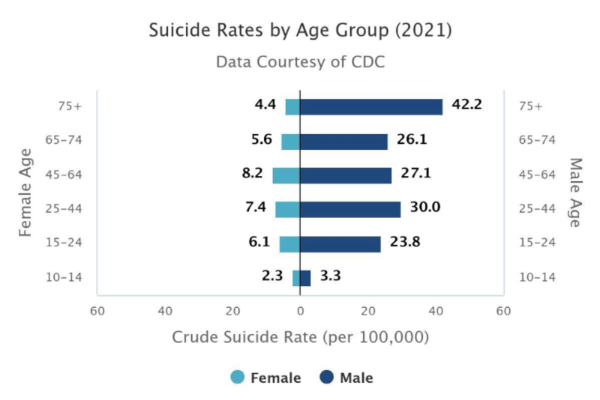
Fig 1. A graph of suicide rates by age group
https://www.nimh.nih.gov/health/statistics/suicide
So how can we make a difference? It starts with talking about it. Spreading awareness and finding other men who have broken the stigma to share their stories. Mauro Ranallo, a Canadian sports announcer, commentator, and mental health advocate said, “I believe the biggest stigma right now, with mental health, is that a lot of men aren’t talking about it.” (45 Quotes) Let’s hear from the men that are talking about it. A man named Rob Wang presented a Ted Talk titled “On Masculinity and Mental Health” where he speaks about his own experience of depression, how his idea of masculinity stopped him from having emotions, and how one day those emotions could no longer be suppressed, and he found himself wanting to take his own life. His story is just one of many examples of men who found themselves against the struggles and hurdles of life and almost gave up. Rutgers’ Ghinassi, President and CEO of University Behavioral Health Care said, "If you tell a young person, 'You can be anything you want,' that's a setup. That's not exactly how the world works. A better thing to tell somebody is to say, 'If you work hard, and you accept struggle and you can put up with setbacks, there are many, many important and wonderful things you can achieve.'"(Diamond) That’s where it starts. Raising men with the belief they can do anything they want along with being told not to cry or show emotions. All humans, male and female, need realistic expectations, and it’s realistic to have setbacks and struggles. You just need to know how to cope with difficult circumstances and emotions.
Many men just do not want anything to do with therapy, but seeing a doctor for an underlying issue may lead to a diagnosis of anxiety and depression anyway. I wanted to hear more about men’s mental health from a male’s perspective in the medical field and how mental health influences physical health. I interviewed Jacob Jamsa, a Nurse Practitioner who specializes in Men’s Health at Castle Rock Medical.
Me: How often do you see a man for anxiety/depression, and how often do you find depression as the underlying cause of something else?
Jacob Jamsa, NP: I usually evaluate depression when someone comes in for an initial visit about testosterone. Also, I do a PHQ-2 (depression scale) with all the yearly physicals. Gut issues closely correspond with mental health issues, so I often have that in the back of my brain as well. 95% of the serotonin in your body is produced in your gut. If your gut health is bad, so is your mental health.
So, it’s not just suppressed emotions that could cause anxiety/depression. Gut health and other factors could be closely related to why men feel the way they do. But how would someone know if they didn’t seek help? Many men don’t want to go to a therapist so it’s nice to know that a lot of health care providers are now looking for anxiety and depression in a medical appointment.
Seeking therapy is crucial for men’s mental health issues just like it’s crucial to seek medical attention for physical health issues. Let's take the visual of an open wound for example. Imagine a huge gash on your leg that won’t stop bleeding and needs medical attention. You choose to ignore it, and soon the bleeding stops, and you think it’s ok, but over time that open wound is at risk for infection. Soon, that infection will spread throughout the body. You chose not to get help and ignored the signs of infection and now you’re at the risk of losing your life. Infection spreading is like suppressing your emotions. Men learn to bottle up their sadness, anger, and hard feelings, and over time they slowly stop feeling anything. Men no longer can feel happiness and joy, they just feel numb. Until one day they can’t ignore that infection any longer. They either choose to seek help or allow it to take their life.
Aside from not wanting to be seen as weak, there are other reasons men argue that therapy isn’t needed. They view a therapist as someone who is going to “talk” about the problem and not fix it. They see therapy as a cop out, a shoulder to cry on, and something that isn’t going to fix the issue. However, therapists know the difference between men and women, and they have a gender-sensitive approach so a woman’s therapy experience is not the same as a man’s. A man’s experience will be tailored to their gender and the societal pressures they experience. The men I have spoken to have told me their therapy experience was like talking to a friend, a safe space to express their emotions and find solutions to work through them. When a man does go to therapy, the therapist is more likely to focus on the solution, not the emotion behind the problem.
This is why we need to talk about it and break the stigma. Seeking therapy is crucial for Men’s mental health. Men need to know that it is a sign of strength to reach out for help, not weakness. They need to feel accepted for having emotions and feelings. More men need to speak about this, there needs to be a bigger movement. If you are reading this, you can make a difference. Whether you’re a male or female, spread awareness, talk to the males in your life, and be the safe space for them to be vulnerable. As society starts to recognize the importance of mental health for everybody, men should feel encouraged to prioritize their mental health and seek therapy. We know by now that a man taking the step to seek therapy will not only improve their life, but the lives of others, and set an example for others to follow. If you or a loved one is experiencing suicidal thoughts, reach out for help immediately. The National Suicide Prevention Lifeline can be reached at 988 and is available 24/7.
Works Cited
“45 Quotes from Influential Men to Help You Connect with Your Emotions.” BetterHelp, 19 Feb. 2024, www.betterhelp.com/advice/mental-health-of-men-and-boys/45-quotes-from-influential-men-to-help-you-connect-with-your-emotions/.
Diamond, Michael L. "Laundromat Helps Man Fight Depression: Draws Attention to Mental Health Challenge." Asbury Park Press, May 12, 2023, ProQuest. https://www.proquest.com/newspapers/laundromat-helps-man-fight-depression/docview/2812263868/se-2 Accessed 13 Apr. 2024.
Jamsa, Jacob. “Personal Interview” 11 April 2024.
"Suicide." 2021. National Institute of Men's Health. Figure 1. 13 April 2024. https://www.nimh.nih.gov/health/statistics/suicide
“Suicide Statistics” May 2023. American Foundation of Suicide Prevention. 11 April 2024.
www.afsp.org/suicide-statistics
“Therapy for Men.” Thought Partners, 26 July 2023, mythoughtpartners.com/therapy-for-men/.
Wang, Rob. "On Masculinity and Mental Health." TED, September 2021. Video. 13 April 2024. https://www.ted.com/talks/rob_wang_on_masculinity_and_mental_health
“Why Men’s Mental Health Is Important.” Men’s Mental Health, ADAA, adaa.org/find-help/by-demographics/mens-mental-health. Accessed 23 Apr. 2024.